As organizations increasingly deploy AI agents that operate autonomously and unpredictably, traditional identity and access management (IAM) systems fall short. To address this, HashiCorp Vault introduces native AI agent support—a suite of capabilities designed specifically for the unique security requirements of autonomous, non-deterministic actors. This article answers common questions about these new features, including the agent registry, granular identity-based policies, per-request ephemeral authorization, and delegation controls.
Why do AI agents require a fundamentally different IAM model than traditional users or workflows?
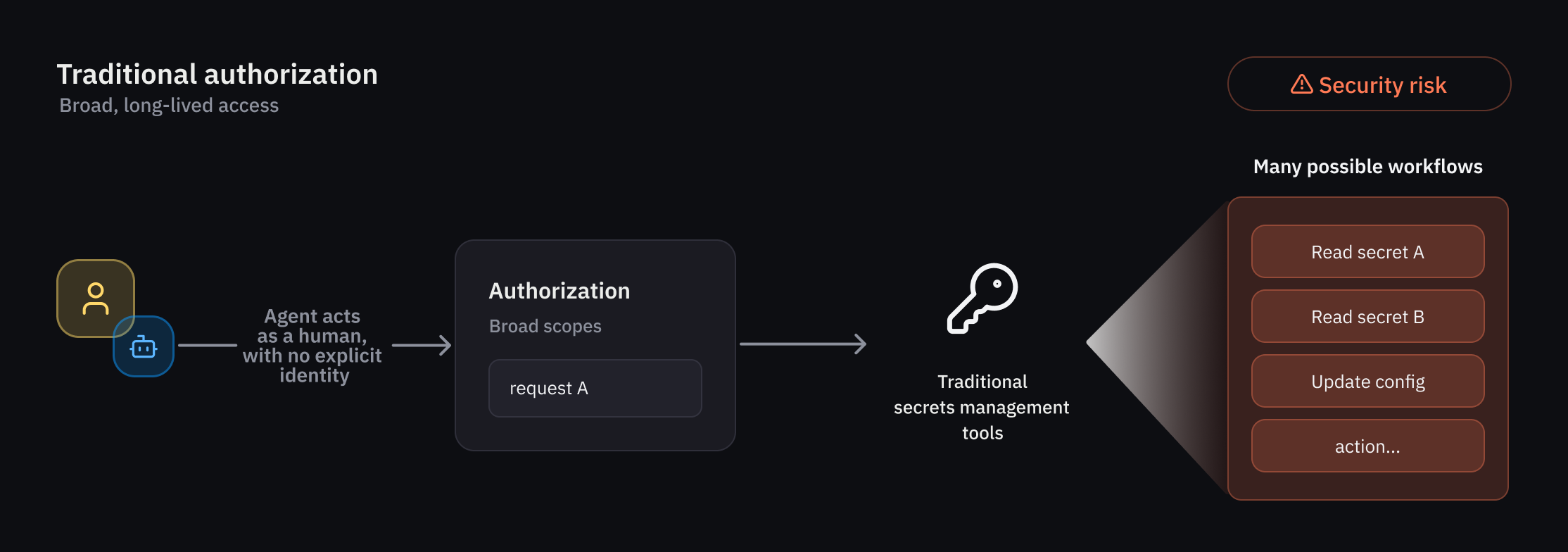
Traditional IAM was built for deterministic users and predictable workflows where actions and access needs are known in advance. AI agents, however, are autonomous and non-deterministic—they make decisions in real time, often based on changing contexts. This introduces a need for a new authorization model that combines identity, delegation, runtime policy evaluation, and ephemeral authorization. Unlike human users or static non-human identities (NHIs), agents require access that is temporary, tightly scoped to a specific transaction context, and evaluated at runtime. Without these controls, organizations risk granting overly broad permissions that can be exploited if an agent is compromised or behaves unexpectedly. HashiCorp Vault’s new capabilities directly address these challenges by providing a dedicated framework for registering, authorizing, and auditing AI agents across environments.
What key capabilities does HashiCorp Vault now offer for securing AI agents?
HashiCorp Vault introduces three core capabilities designed specifically for agentic workflows. First, an agent registry allows developers to register and manage agent activity separately from human and traditional NHIs, providing agent-specific oversight. Second, granular identity-based policies enforce least-privilege access through deterministic guardrails and runtime controls, even when agent behavior is unpredictable. Third, per-request authorization (ephemeral authorization) grants temporary access rights that expire after a specific task or timeframe, reducing risk by limiting exposure. Together, these capabilities ensure that AI agents can operate securely with clear attribution, fine-grained scoping, and tight integration with existing Vault policies and audit trails.
How does the agent registry work, and why is it important?
The agent registry is a new primitive in Vault that separates AI agent identities from human and traditional non-human identities. Developers can register agents, assign them unique identities, and manage their lifecycle separately. This separation is critical in delegation flows, such as when an agent acts on behalf of a user using an on-behalf-of (OBO) pattern. By explicitly tracking this delegation, the registry ensures that every action is attributable to both the agent and the user who authorized it. It forms the starting point for a dedicated framework of registration, authorization, credential management, and observability. Without such a registry, organizations would struggle to distinguish agent activity from human activity, making it difficult to enforce agent-specific policies or audit actions performed by autonomous systems.
What are granular identity-based policies for agents, and how do they enforce least privilege?
Granular identity-based policies in Vault allow administrators to strictly govern agent activity through deterministic guardrails and runtime controls. Because agent behavior can be non-deterministic, these policies enforce per-request access control, ensuring that agents only access the secrets and credentials they need for a specific action. For example, an agent might be permitted to retrieve a database password only when performing a data analysis task, and only if the request originates from a specific IP range. Additionally, when agents operate in delegation mode—carrying the authority of a human user—Vault evaluates trust across multiple dimensions (e.g., user identity, agent identity, and context) before granting access. This multi-dimensional evaluation ensures that least privilege is maintained even in complex delegation scenarios.
What is per-request (ephemeral) authorization, and how does it reduce risk?
Per-request authorization, also called ephemeral authorization, grants access rights that are temporary and tightly scoped to a specific task or transaction context. For AI agents, this is crucial because their actions are often short-lived and unpredictable. Instead of issuing long-lived credentials, Vault issues credentials that expire after the request is completed or after a short, configurable timeframe. This limits the window of opportunity if the agent is compromised or misused. For example, an agent that needs to read a secret to generate a report will receive a credential that expires immediately after that report is generated. This approach dramatically reduces risk compared to traditional static tokens or service accounts that remain valid for extended periods.
How does Vault handle delegation and accountability for AI agents acting on behalf of users?
In delegation scenarios, AI agents often act on behalf of a human user using an on-behalf-of (OBO) pattern. Vault addresses this by explicitly tracking the delegation chain—every action performed by an agent is linked to both the agent identity and the human user who authorized it. This is made possible through the agent registry and granular policies that evaluate trust across multiple dimensions. For instance, when an agent requests a secret, Vault checks not only the agent’s identity but also the user’s consent and the context of the request. All actions are logged with full attribution, providing clear auditability for compliance and incident response. This ensures that organizations can answer the question, “Who or what did what, and who authorized it?” in real time.
When will HashiCorp Vault’s AI agent capabilities be generally available?
HashiCorp Vault’s new AI agent support is currently in an early access program, with select customers evaluating the agent registry, granular policies, and ephemeral authorization features. A broader public beta is planned for release in the summer of 2025. Organizations interested in participating can reach out to HashiCorp for early access details. Once generally available, these capabilities will be integrated into the standard Vault release, providing a standardized approach for securing AI agents across hybrid and multi-cloud environments. The features are designed to complement existing Vault functionality for secrets management, identity-based access, and audit logging.
What is the overall benefit of Vault’s approach to AI agent security?
HashiCorp Vault’s native AI agent support provides organizations with a unified, robust framework for managing identity and access for autonomous systems. By separating agent identities, enforcing granular runtime policies, and issuing ephemeral credentials, Vault reduces the risk of lateral movement and privilege escalation. The explicit delegation tracking and rich audit trail ensure accountability and compliance, even in complex agent workflows. This approach addresses the unique operational and security characteristics of AI agents, enabling organizations to adopt AI automation confidently without compromising security. Ultimately, Vault transforms agentic AI from a security liability into a well-governed, auditable resource.